

Clinical benchmarks define a sustainable weight loss rate as losing one to two pounds per week. Reaching this biological target requires a calculated energy deficit. Combining a mathematically controlled diet with mechanical tension and cardiovascular demand is the most effective approach.
When you search for the best gym exercise to lose weight, you must focus on movements that recruit multiple muscle groups and elevate your heart rate significantly. Vivagen Health promotes evidence-based strategies to optimize your metabolic rate and body composition.
Compound Lifts: The Core of Weight Loss Training
Compound exercises are the anatomical foundation of resistance training. By forcing multiple muscle groups to move an external load simultaneously, they demand massive cellular energy production. This high recruitment burns significant calories during the workout and afterward through excess post-exercise oxygen consumption (EPOC). The resulting mechanical tension also prevents muscle atrophy.

Barbell Squats and Deadlifts
Barbell squats and deadlifts are fundamental movements for building strength and accelerating fat loss. Squats target the quadriceps, hamstrings, and glutes through knee and hip flexion. Deadlifts heavily recruit the posterior chain, including the erector spinae, latissimus dorsi, and gluteus maximus, via a hip hinge mechanism.
Performing these heavy lifts requires immense central nervous system activation and massive caloric expenditure. Proper form dictates keeping the spine neutral and driving the load through the mid-foot. This generates maximum mechanical tension to preserve lean mass during a caloric deficit.
Bench Press and Overhead Press
Upper body compound movements generate a high metabolic demand. The barbell bench press activates the pectoralis major, anterior deltoids, and triceps brachii. Scapular retraction during this movement protects the shoulder joint and isolates the chest muscles. The overhead press targets the entire shoulder complex and requires rigid core engagement to maintain an upright posture. Integrating these vertical and horizontal pushes into your routine builds upper body density. This additional muscle mass directly increases your resting metabolic rate.
>>> Read more: https://blog.nasm.org/nutrition/resting-metabolic-rate-how-to-calculate-and-improve-yours
Dynamic Lunges and Step-Ups
Unilateral exercises like dynamic lunges and step-ups challenge your balance, proprioception, and coordination. Working one leg at a time corrects bilateral muscle imbalances and strengthens stabilizing tendons. These movements also elevate your heart rate rapidly as blood flows to large peripheral muscle groups. Adding heavy dumbbells or kettlebells to these exercises increases the gravitational load and maximizes calorie burn. Maintaining an upright torso and stepping firmly through the heel optimizes gluteal activation during these movements.
High-Intensity Cardio Machines for Rapid Calorie Burn
While heavy weightlifting builds metabolically active muscle tissue, cardiovascular exercise directly oxidizes stored fat. Using gym equipment effectively can accelerate your progress toward a sustainable weight loss rate.

Treadmill Sprints and Incline Walking
Treadmill routines offer excellent options for metabolic conditioning. Sprint intervals drive your heart rate into the anaerobic zone to challenge your VO2 max and expend massive energy rapidly. Alternatively, incline walking at a steep gradient provides a low-impact method to maintain an elevated heart rate for fat oxidation while minimizing shear stress on your patellar tendons.
Rowing Machine Intervals
The ergometer provides a full-body cardiovascular workout. Unlike static cycling, rowing engages the back, arms, core, and legs in a continuous, fluid motion. The rowing stroke consists of the catch, drive, finish, and recovery phases. Mastering this specific sequence ensures maximum power output. Short intervals of maximum effort on the rower drastically increase cardiovascular endurance and deplete glycogen stores rapidly.
| Cardio Method | Primary Energy System | Muscle Groups Recruited | Joint Impact Level | Target Duration |
| Treadmill Sprints | Anaerobic | Lower Body | High | 15-20 Minutes |
| Incline Walking | Aerobic | Lower Body | Low | 30-45 Minutes |
| Rowing Intervals | Anaerobic & Aerobic | Full Body | Low | 15-25 Minutes |
Functional Training and Explosive Movements
Functional training mimics everyday biomechanical patterns while adding resistance and high velocity. This style of physical training improves agility, explosive power, and metabolic conditioning.
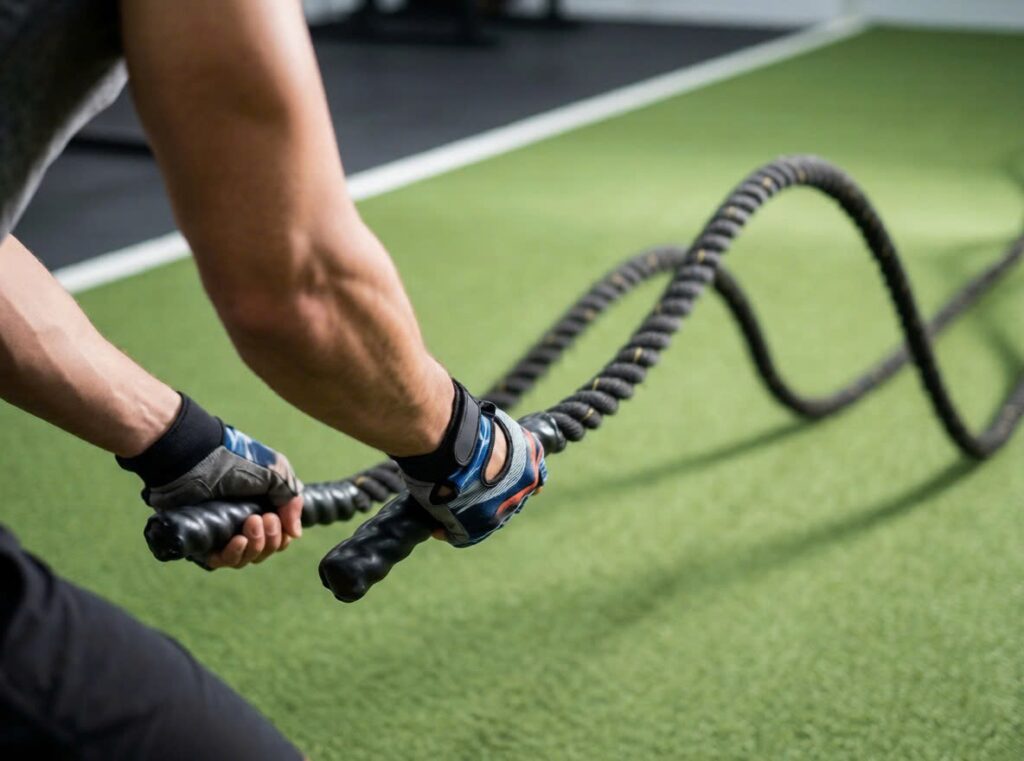
Kettlebell Swings and Battle Ropes
Kettlebell swings build explosive hip extension power and posterior chain endurance. The continuous pendulum motion, driven by a forceful hip snap, rapidly elevates your heart rate. Battle ropes provide a unique upper body cardiovascular challenge. Generating sustained waves with heavy ropes quickly fatigues your anterior deltoids, biceps, and core musculature to maximize caloric expenditure.
Plyometric Box Jumps and Burpees
Plyometrics involve the rapid stretching and contracting of muscle fibers to generate force. Box jumps build lower body power and demand high ATP output. The amortization phase must be brief to maximize the stretch-shortening cycle. Burpees combine a deep squat, active plank, push-up, and vertical jump into a single continuous sequence. These bodyweight movements are exhausting and highly effective for torching calories quickly within a confined space.
Structuring Your Lose Weight Exercise at the Gym Routine
Selecting the right anatomical movements is only the first step. You must organize these exercises logically to maximize their physiological benefits and maintain a sustainable weight loss rate. A well-designed lose weight exercise at gym plan balances total volume, training intensity, and necessary recovery time.
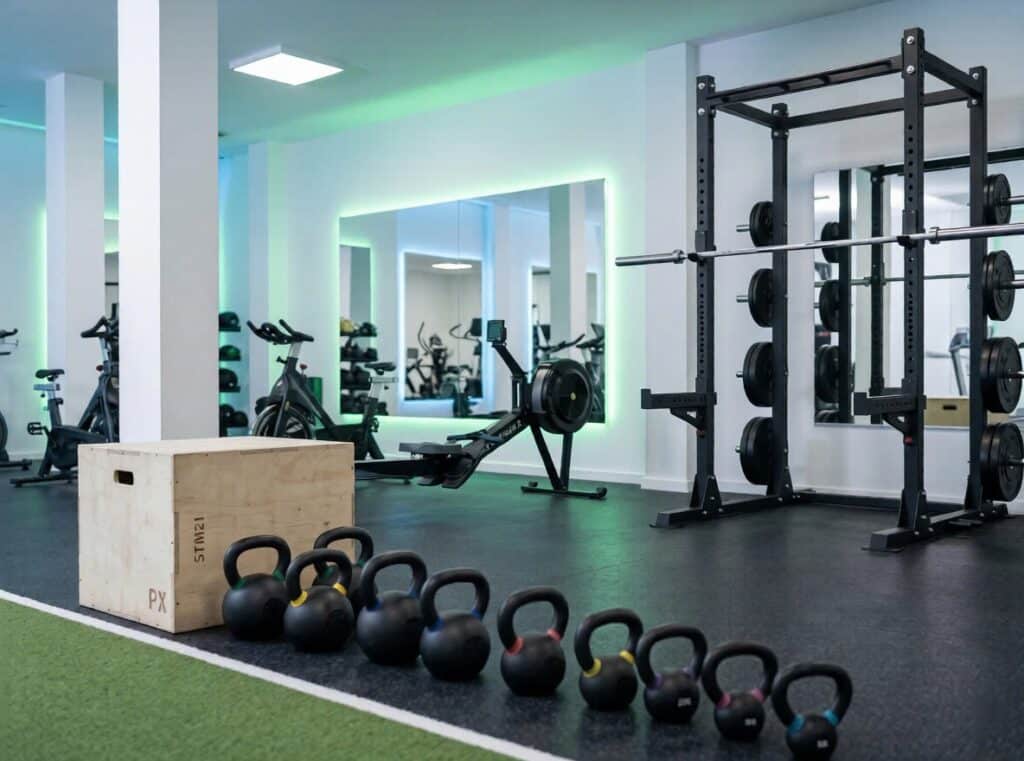
Circuit Training vs. Super-Sets
Organizing your workouts to minimize rest periods keeps your heart rate high and maximizes time efficiency.
- Circuit Training:
This method involves moving through multiple exercises back-to-back with minimal rest. You might transition from barbell squats to rowing intervals to plyometric burpees before taking a break. This approach maximizes cardiovascular demand and localized muscular endurance. Circuit training forces the body to adapt to rapid shifts in blood flow distribution.
- Super-Sets:
This programming technique pairs two exercises together. You complete a set of the first exercise and immediately perform the second without resting. Pairing antagonistic muscle groups allows one muscle to recover while the opposite muscle works. This increases total workout density.
Consistency and Progressive Overload
Long-term morphological success relies on consistent physical effort and strategic mechanical progression.
- Train at least three to four days per week to trigger measurable adaptations in body composition.
- Apply progressive overload by gradually increasing the external weight, total repetitions, or total sets over several weeks.
- Track your workouts meticulously to ensure you are continually challenging your muscular and cardiovascular systems.
- Monitor your macronutrient intake alongside your training regimen to guarantee you remain in a calculated energy deficit.
- Prioritize eight hours of sleep and adequate hydration to support muscle tissue repair and baseline metabolic function.
>>> Read more: https://vivagenhealth.com/medically-supervised-weight-loss-clinic/
Achieve Healthy Weight Reduction with Precision Programming
Achieving clinical benchmarks for healthy weight reduction requires precise programming and discipline. By combining heavy multi-joint lifts, intense cardiovascular intervals, and explosive functional movements, you can optimize your physical health. Please contact our experienced staff at our Coral Ridge Mall location at 954-440-6468 or our Broward Mall location at 954-372-2471 to explore evidence-based strategies for fitness and longevity.